
Summary
This article explores why human imagination continues to play a central role in the creative industries, despite the rapid rise of AI-generated content. It analyzes the distinctions between production and intention, the importance of human judgment in ensuring quality, and the unique cultural and ethical insights that only humans can provide. The piece argues that the next decade of creativity will be defined by hybrid workflows where humans and AI collaborate, rather than compete.
Artificial intelligence has transformed the way creative work is produced, distributed, and consumed. From image generation to automated writing, AI tools now perform tasks that once required years of human training. This shift has reshaped global creative industries and raised fundamental questions about originality, authorship, and the future of human expression.
Yet despite the scale and speed of these tools, a consistent insight emerges across research, case studies, and industry trends:
AI expands creative capacity, but does not replace the role of human imagination.
This article examines why human creativity remains central — and what this means for the next decade of Human-AI collaboration.
1. Creativity Is Not Just Production — It Is Intention
AI excels at generating outputs. It can produce hundreds of images, texts, or melodies within seconds.
But creativity is not synonymous with production.
Human creativity stems from:
- lived experience
- cultural memory
- emotional interpretation
- aesthetic judgment
- ethical and philosophical context
These elements cannot be replicated by algorithms trained on statistical patterns.
AI can assist with form, but humans provide meaning — and meaning is ultimately what defines creative value.
2. AI Offers Scale, but Humans Curate Quality
One of the most documented risks in AI-generated content is the “abundance effect”: the internet becomes saturated with endless works that lack uniqueness.
This challenge increases the importance of human roles such as:
- curation
- editing
- quality assessment
- narrative framing
- cultural contextualization
Studies from the Oxford Internet Institute and Stanford HAI consistently show that audiences trust creative work more when it includes explicit human oversight.
The future is not about choosing between humans and machines, but about leveraging both:
machines to expand possibilities, and humans to refine them.
3. Imagination Requires Constraints — AI Does Not Understand Them
Research in cognitive science suggests that constraints are a core engine of creativity.
Humans innovate because they face limitations — of time, resources, knowledge, or tools.
AI, however, has no intrinsic sense of constraint.
Its “creativity” is combinatorial: it recombines patterns from data.
This difference explains why AI can generate thousands of ideas, but struggles to decide which idea matters — or why.
Humans supply narrative direction.
AI supplies exploratory diversity.
Together, they form a cycle that neither can complete alone.
4. Cultural and Ethical Understanding Remains Uniquely Human
Creativity is embedded within:
- social norms
- ethical boundaries
- cultural contexts
- historical references
An AI model trained on global data cannot inherently distinguish between culturally sensitive expressions and generic outputs.
This gap has led to several documented cases where AI-generated content unintentionally reproduces stereotypes or violates cultural expectations.
Human creators remain essential for:
- ethical decision-making
- cultural interpretation
- safeguarding representation
- ensuring authenticity
As UNESCO’s 2023 guidelines emphasize, AI can support cultural work — but cannot determine cultural meaning.
5. The Next Decade: Hybrid Creativity as the New Standard
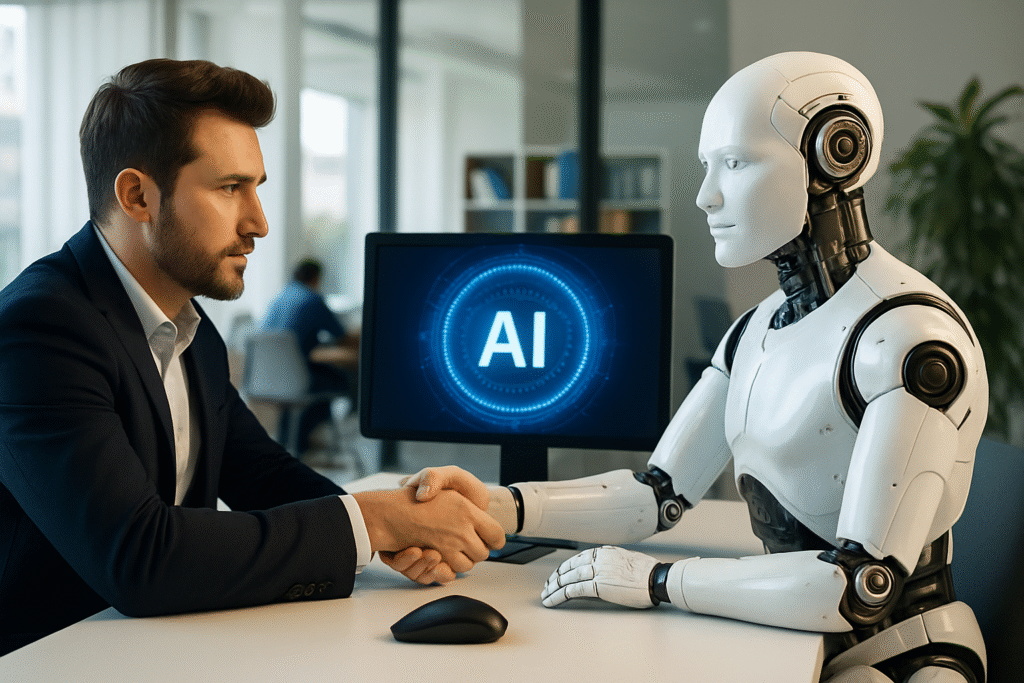
Creative industries are shifting from “human vs. AI” to hybrid workflows where each side complements the other:
- Humans define narrative purpose, quality standards, voice, emotion, and originality.
- AI accelerates exploration, visualization, drafting, and experimentation.
This hybrid model is reshaping:
- publishing
- design and illustration
- music and film
- education
- research
- interactive media
The highest-performing creative teams of the next decade will likely be those that treat AI as a collaborator — not a competitor.
Conclusion
AI challenges old structures of creativity, but it does not diminish the value of human imagination.
Instead, it amplifies the need for:
- intentionality
- judgment
- ethics
- cultural awareness
- quality curation
The future of creative work belongs to those who understand both worlds — the imaginative depth of the human mind and the generative power of intelligent tools.
In this future, the question is no longer whether AI can create, but how humans choose to direct that creation.